
What Is DOA?
DOA stands for Direction of Arrival. It refers to estimating the direction from which a sound reaches the microphone.
In smart cameras, conference systems, robots, and voice-interaction devices, the system may need to do more than simply “hear” a sound. It may also need to know which direction the speaker is located in. Once the sound direction is known, the system can perform camera tracking, Beamforming, or other acoustic processing.
What Is Soundskrit’s WXYZ Configuration?
The direction of sound propagation in three-dimensional space can be represented by three perpendicular directional components: X, Y, and Z.
Soundskrit’s WXYZ configuration uses three directional microphone signals to measure:
X: Sound component along the left-right axis
Y: Sound component along the front-back axis
Z: Sound component along the vertical axis
By comparing the X, Y, and Z directional information at the same time, the system can estimate the direction of the incoming sound in three-dimensional space. This is known as DOA estimation.
Why Is a W Microphone Also Needed?
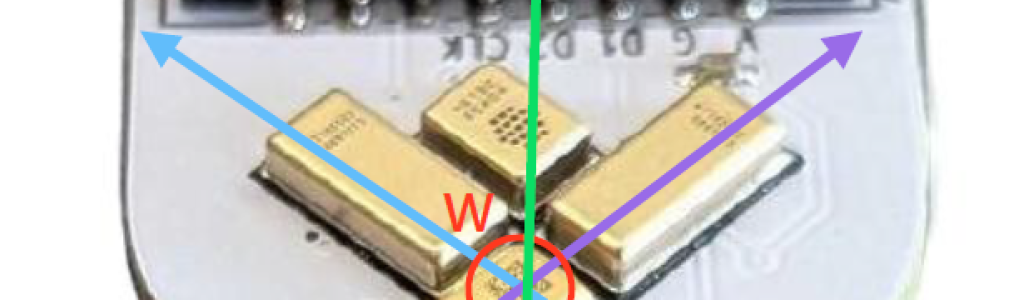
In addition to the X, Y, and Z directional signals, the Soundskrit configuration also includes a W omnidirectional microphone.
The X, Y, and Z directional microphones mainly provide dipole-like directional information, while W provides the omnidirectional sound component. By combining W with X, Y, and Z in different proportions, different pickup patterns can be created, such as a Cardioid pattern. The Beamformer can then be adjusted according to the sound direction detected by the DOA algorithm.
Therefore, WXYZ is not only used to “find the direction.” After the sound source is located, the system can also steer the main pickup direction toward the target sound source.
Are All Four WXYZ Microphones Always Required?
Not necessarily. If the product only needs to determine the sound direction in the horizontal plane and does not need to determine whether the sound comes from above or below, the Z axis can be omitted. In this case, only the following signals are required:W + X + Y
This is sufficient to obtain directional information in the horizontal plane.
If the application requires full three-dimensional sound localization, such as robotics, 360° sound tracking, or other Physical AI applications, adding the Z axis provides additional vertical-direction information.
Butterfly Demo Kit
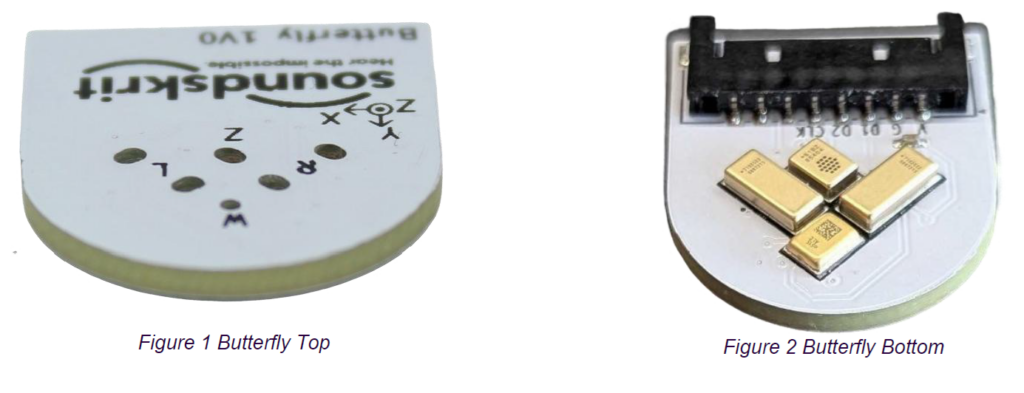
Soundskrit’s Butterfly Demo Kit uses the WXYZ microphone configuration, allowing developers to experience Soundskrit’s Sound Localization and Beam Steering technologies directly.
With this configuration, developers can observe how sounds from different directions are measured by the X, Y, and Z microphones, and then use algorithms to estimate the sound source direction and control the pickup beam.
This allows Directional MEMS technology to serve as more than just an audio-capture component. It can also become an important foundIn Simple Terms
The core idea behind Soundskrit’s DOA technology is not simply to “place multiple microphones together.” Instead, it uses directional MEMS microphones to capture X, Y, and Z three-dimensional directional information, together with the W omnidirectional signal for sound-field analysis and Beamforming.
With this WXYZ configuration, the system can:
Determine where the sound is coming from, track the sound source direction, and focus the pickup toward the target sound source.
For more information about Soundskrit MEMS, please visit AATC’s product pages: SKR0710 SKR0610 SKR0410