
The power level measured using this type of noise signal is usually called rated noise power.In addition to long-duration continuous testing, there is also a less demanding short-term noise test. This type of test does not continuously input noise for 100 hours. Instead, it uses short-duration, higher-power noise signals. For example, noise may be applied for 1 minute, followed by a 2-minute interval, and repeated 10 times. Under this test condition, the speaker should not suffer any permanent damage.Since short-term testing is less demanding than long-duration continuous testing, the noise power that a speaker can withstand under this condition is usually higher. In general, the power obtained from this type of short-term noise test may be approximately twice the rated noise power.
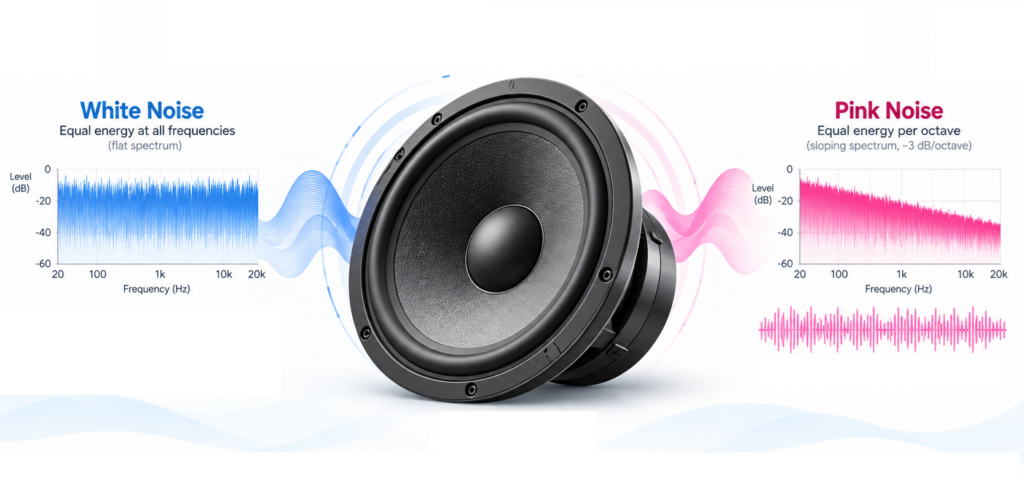
White noise sounds similar to the hiss of an FM radio when no signal is received. It is a type of random noise. In terms of frequency distribution, white noise has approximately equal power at each frequency, so its high-frequency components are relatively noticeable.
Pink noise is also a type of random noise, but its energy distribution is different from white noise. The key characteristic of pink noise is that it has approximately equal power in each octave band, such as 100–200 Hz, 200–400 Hz, and 400–800 Hz. Because this distribution is closer to how the human ear perceives sound, pink noise is also commonly used in acoustic testing and speaker evaluation.
Both white noise and pink noise contain a wide range of frequency components, and they may include more high-frequency and low-frequency energy than many real-world sound sources. In addition, noise signals may also contain instantaneous peaks. These peaks can be used to test how well a speaker handles sudden signals and to observe the response of the cone, diaphragm, or other structures under short-term stress.
However, noise testing can sometimes be too demanding for a speaker. Every speaker has its own operating bandwidth. If the test signal contains too much energy outside the speaker’s intended operating range, it may create a test condition that does not match real applications. Therefore, in practical testing, white noise or pink noise may sometimes be processed with spectrum shaping so that the test signal better represents the sound conditions the product will actually encounter.
Simply put, white noise and pink noise are used to test speakers because they help provide a more complete evaluation of a speaker’s durability and stability under complex sound signals. Compared with a single-frequency sine wave, noise signals better represent the frequency distribution, instantaneous peaks, and long-term loading that speakers may encounter in real-world use. This makes them important tools in speaker reliability testing.