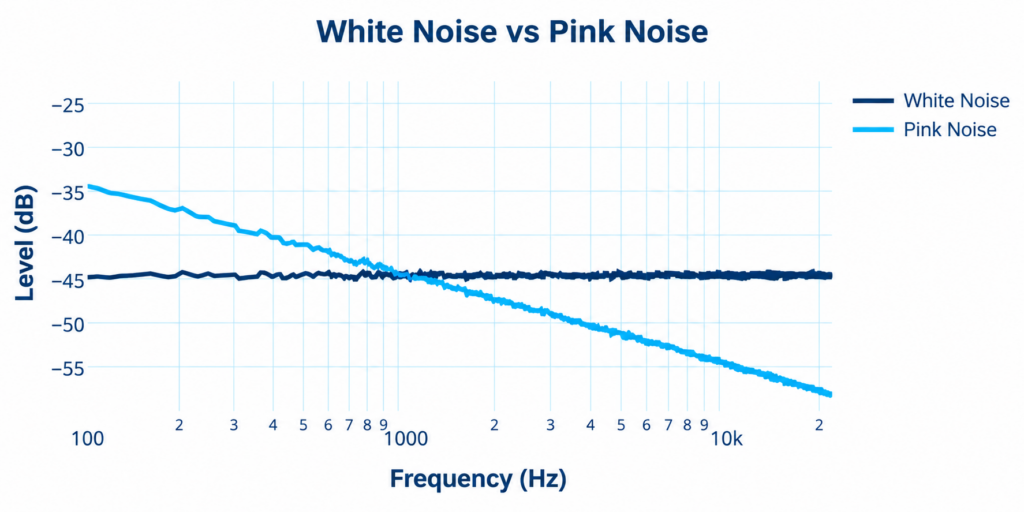

In acoustic testing, white noise and pink noise are both commonly used as test signals. However, when we look at their spectral distribution, we can see that their energy is distributed in different ways.
White noise can be compared to the spectrum of white light. White light contains many visible wavelengths, while white noise contains a wide range of sound frequencies. In terms of frequency distribution, white noise has approximately equal power or energy within the same bandwidth. For example, each 1 kHz bandwidth contains roughly the same amount of energy. Pink noise is also a common type of random noise, but its energy distribution is different from that of white noise. The key characteristic of pink noise is that it has approximately equal power or energy in each octave band. For example, the total energy in 100–200 Hz, 200–400 Hz, and 400–800 Hz is roughly the same.
Therefore, when observing the spectrum of pink noise on a logarithmic frequency axis, its energy gradually decreases as frequency increases, with a slope of about 3 dB per octave. This is why pink noise does not look as flat as white noise.From a naming perspective, pink or red can be understood as the longer-wavelength portion of the white-light spectrum. Similarly, compared with white noise, pink noise contains relatively more low-frequency energy, so it sounds deeper and fuller.
Pink noise is generally considered to be closer to how the human ear perceives sound, so it is commonly used in acoustic measurement, speaker testing, and sound field tuning. Since pink noise contains more low-frequency energy, it can sometimes be a more demanding test signal for speakers, because low frequencies are usually more difficult for speakers to reproduce efficiently than high frequencies.
Therefore, when observing the spectrum of pink noise on a logarithmic frequency axis, its energy gradually decreases as frequency increases, with a slope of about 3 dB per octave. This is why pink noise does not look as flat as white noise.From a naming perspective, pink or red can be understood as the longer-wavelength portion of the white-light spectrum. Similarly, compared with white noise, pink noise contains relatively more low-frequency energy, so it sounds deeper and fuller.
Pink noise is generally considered to be closer to how the human ear perceives sound, so it is commonly used in acoustic measurement, speaker testing, and sound field tuning. Since pink noise contains more low-frequency energy, it can sometimes be a more demanding test signal for speakers, because low frequencies are usually more difficult for speakers to reproduce efficiently than high frequencies.
White noise is often used for testing electronic instruments and equipment. Since white noise has equal energy within the same bandwidth, its spectrum appears more evenly distributed on a linear frequency scale. This makes it suitable for signal analysis and system testing.
In general, white noise usually sounds brighter because it contains more noticeable high-frequency components. Pink noise, on the other hand, sounds deeper and more natural because it has relatively fuller low-frequency energy. Simply put, the main difference between white noise and pink noise lies in how their energy is distributed across frequency. White noise is useful for observing energy distribution within equal bandwidths, while pink noise is closer to human hearing perception and is widely used in acoustic testing.
In general, white noise usually sounds brighter because it contains more noticeable high-frequency components. Pink noise, on the other hand, sounds deeper and more natural because it has relatively fuller low-frequency energy. Simply put, the main difference between white noise and pink noise lies in how their energy is distributed across frequency. White noise is useful for observing energy distribution within equal bandwidths, while pink noise is closer to human hearing perception and is widely used in acoustic testing.