
Can the Sound Level Meter Itself Affect the Sound?
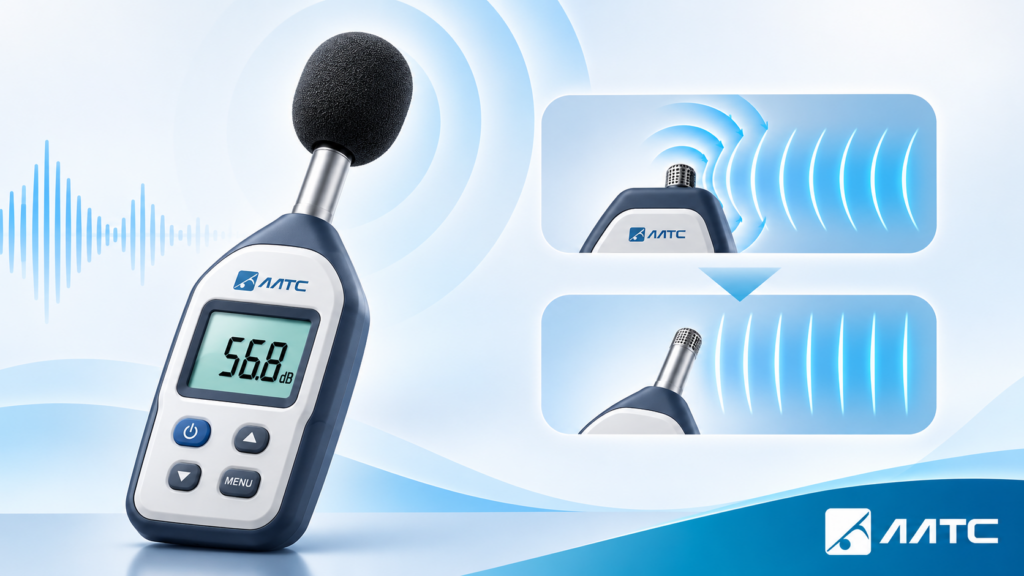
When using a sound level meter, we want the microphone to measure a sound field that is as close as possible to the original acoustic environment.However, the body of the sound level meter is also a physical object.When sound waves reach the instrument, they can interact with its surfaces, edges, and corners, producing reflection, scattering, and diffraction. These additional sound waves may reach the microphone again and combine with the original incident sound, changing the measured sound pressure level.Therefore, the sound level meter itself can become a source of interference in the measurement.
Why Are High Frequencies More Easily Affected?
The degree to which sound is affected by the shape of an object depends greatly on the relationship between the wavelength and the size of the object. Low-frequency sounds have long wavelengths. Compared with the dimensions of a sound level meter, these waves can more easily bend around the instrument, so the local influence of the meter body is usually less significant. At higher frequencies, however, the wavelength becomes shorter and may become comparable to the dimensions of the meter body, its edges, or other structural features. In this case, reflections and diffraction caused by the instrument may increase or decrease the sound pressure at certain frequencies, resulting in errors in high-frequency measurements.
Why Is the Microphone Mounted on a Long, Thin Cylinder?
Modern sound level meters usually place the measurement microphone on a long, smooth, and relatively thin cylindrical structure extending away from the main body. The main purpose is to keep the microphone at some distance from the larger instrument housing. The farther the microphone is from the main body, the less likely reflections and diffraction from the housing and its edges are to directly affect the microphone. This helps reduce disturbance to the sound field caused by the sound level meter itself. At the same time, a thin and smooth cylindrical shape interferes with the sound field less than a wide body or a structure with sharp edges. Therefore, this long, thin section is not simply a “microphone holder.” It is actually part of the acoustic design of the sound level meter.
Why Do Sound Level Meters Usually Have Smooth Shapes?
In addition to extending the microphone away from the main body, modern acoustic measurement instruments are often designed to avoid large flat surfaces, protrusions, or sharp edges near the microphone. The reason is the same: to minimize the influence of the instrument itself on the sound field. Ideally, the microphone should behave as though it were “standing alone” in the acoustic field, measuring the original sound as much as possible instead of sound that has already been reflected by the instrument housing. Therefore, the microphone position, the dimensions of its supporting structure, and the shape of the instrument housing can all affect the frequency response and measurement accuracy of a sound level meter.
In Simple Terms
The main reason a sound level meter places its microphone on a long, thin extension is: To keep the microphone away from the main body and reduce the effects of reflection, scattering, and diffraction caused by the instrument itself.
This is especially important at high frequencies, where the shorter wavelengths are more easily affected by the dimensions and shape of the instrument. So, the next time you see the long, thin microphone section on a sound level meter, you can think of it this way: it is not just for appearance—it helps prevent the instrument from interfering with the very sound it is trying to measure.