

The siren sounds used by ambulances, police cars, and fire trucks are not only about being loud enough. In actual design, factors such as frequency range, sweep speed, vehicle sound insulation, background noise, and sound directivity must also be considered. These factors affect whether nearby drivers can hear the siren in time and identify the location of the emergency vehicle.
Common Types of Siren Sounds
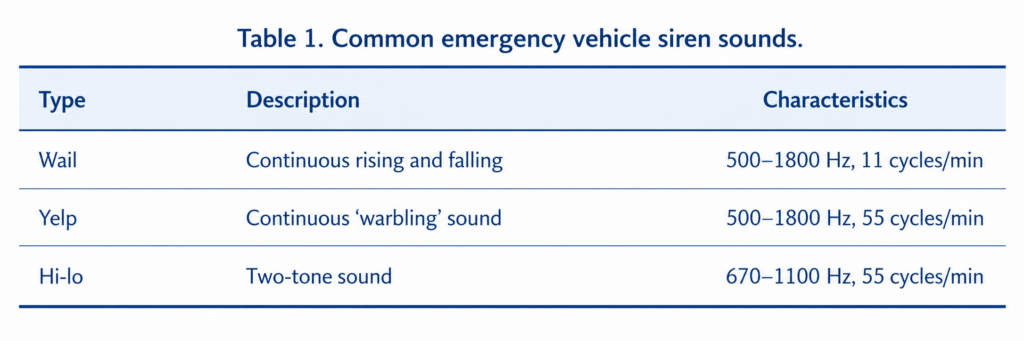
Common emergency vehicle siren sounds can generally be divided into several types, including Wail, Yelp, and Hi-Lo
Wail refers to a relatively slow rising and falling sound. It sounds like the frequency gradually increases and then gradually decreases. This type of sound is usually closer to a logarithmic sweep rather than a linear sweep, so it sounds more natural and continuous. Wail has fewer cycles per minute, with around 11 cycles/min to 15 cycles/min being a common range. Its frequency range can refer to 500 Hz to 1,800 Hz, although some products may be designed around 800 Hz to 1,700 Hz.
Yelp is a faster and more urgent rising and falling sound. Because the sweep speed is faster, it has many more cycles per minute than Wail. Yelp usually creates a stronger sense of urgency, so it is often used in situations where surrounding vehicles need to be alerted and react quickly.
Hi-Lo refers to a siren sound that alternates between two single-tone frequencies, such as switching back and forth between a high tone and a low tone. In general, around 40 to 60 cycles/min is a common design range. This type of sound is easy to recognize and is also commonly used in emergency vehicles and warning equipment.
In general, the faster the sweep speed and the more urgent the sound, the easier it is for people to perceive a sense of emergency. If the sweep is too slow, the sound may still be noticeable, but it may create less tension or urgency.
Common Frequency Ranges Used in Sirens
The frequency ranges mentioned above can be used as design references, but the actual frequency of a siren may still vary depending on the product positioning and application scenario. If the siren sound mainly falls between about 100 Hz and 1,000 Hz, it is usually considered a lower-frequency siren design, such as a rumbler siren. This type of sound contains more low-frequency components, making it easier to penetrate or diffract around certain obstacles. It is also more likely to transmit through vehicle structures. In terms of waveform, a simple sine-wave pure tone is not necessarily the easiest sound for the human ear to detect. In real applications, sirens often use more complex sounds, such as complex tones or square waves. Since square waves contain more harmonic components, they can still have a strong warning effect on the human ear even when the fundamental frequency is below 1,000 Hz.
Why Is a Higher Frequency Not Always Better for Vehicle Sirens?

For vehicle-mounted applications, siren frequencies are usually not designed to be too high, such as above 3,000 Hz or 4,000 Hz. This is because the vehicle itself provides sound insulation and filtering effects. Structures such as the vehicle body, windows, doors, and interior materials all cause transmission loss. High-frequency sound in particular is usually attenuated more significantly when passing through vehicle structures. In other words, when an external siren sound reaches the driver’s seat inside the vehicle, its high-frequency components may already be greatly reduced. When combined with in-cabin background noise, such as engine noise, air-conditioning noise, road noise, or audio system sound, an overly high-frequency siren may actually be difficult for the driver to hear. The figure shows the possible background noise heard at the driver’s seat under different conditions. The sound pressure level of the siren must be higher than this background noise in order to have a sufficient chance of being noticed by the driver.
Low Frequencies and High Frequencies Each Have Their Own Advantages
For sirens, both low-frequency and high-frequency sounds have their own advantages. Low-frequency sound usually has lower transmission loss and is better at diffracting around obstacles. Therefore, in environments where vehicles, buildings, or other objects may block the sound, low-frequency siren sounds may reach the driver’s ear more easily. This is why low-frequency warning sounds such as rumbler sirens have practical value. However, the frequency should not be too low. According to the equal-loudness contour, the human ear is not very sensitive to very low-frequency sound. In other words, if the frequency is too low, even when the actual sound pressure level is not small, the perceived loudness may still be limited. High-frequency sound has another advantage: it provides a clearer sense of direction. The human ear is better at judging the direction of high-frequency sound, so high-frequency components can help drivers identify where the siren is coming from. However, high-frequency sound is also more easily attenuated by the vehicle body and sound-absorbing materials, so it may not transmit effectively into the cabin. Therefore, siren design should not rely only on low frequencies or only on high frequencies. It must consider human hearing, vehicle sound insulation, transmission loss, and real road environments at the same time.
Directivity Is Also an Important Part of Siren Design
A siren must not only be loud enough; its sound must also propagate in the right directions.
If the goal is for pedestrians and drivers from many different directions to hear the siren, the siren directivity cannot be too narrow. It must have a sufficiently wide coverage angle. This is especially important when an ambulance passes through an intersection. Not only the vehicles in front need to hear the siren; vehicles on the left and right sides, perpendicular to the ambulance’s direction of travel, also need to notice it. Therefore, the sound coverage of the siren in the left and right directions, roughly within ±90 degrees, is very important. In practical design, the industry usually pays special attention to the sound performance within at least ±50 degrees to ensure that the siren sound is not concentrated only in the forward direction. On the other hand, high-frequency sound usually has stronger directivity, which helps people identify the sound source. Low-frequency sound, however, is more likely to spread and diffract. This is why siren design needs to balance frequency, directivity, and the actual installation position.
How Much Louder Should a Siren Be Than the Background Noise?
In an environment with background noise, the siren sound must be higher than the background noise in order to be heard easily. In general, if the sound pressure level of the target sound is about 6 to 10 dB higher than the background noise, listeners can usually notice the sound clearly. If the target sound is more than 15 dB higher than the background noise, listeners can usually become alert and react more quickly. Therefore, when designing a siren, it is not enough to look only at the siren’s output sound pressure level. The background noise in the actual environment must also be evaluated. For vehicle-mounted sirens, the most important question is whether the sound can pass through the vehicle body, overcome in-cabin noise, and be noticed by the driver in time.
Summary
The frequency design of an ambulance siren is not simply about making the sound higher-pitched or louder. It requires a balance between multiple factors. Wail, Yelp, and Hi-Lo represent different siren sound patterns. Low-frequency sound is better at penetration and diffraction, while high-frequency sound provides better directional cues. In actual design, transmission loss caused by vehicle structures, background noise at the driver’s seat, human hearing characteristics, and the directivity of the siren itself must also be considered. In other words, an effective ambulance siren must allow people to hear it, recognize its urgency, and ideally identify where the sound is coming from.