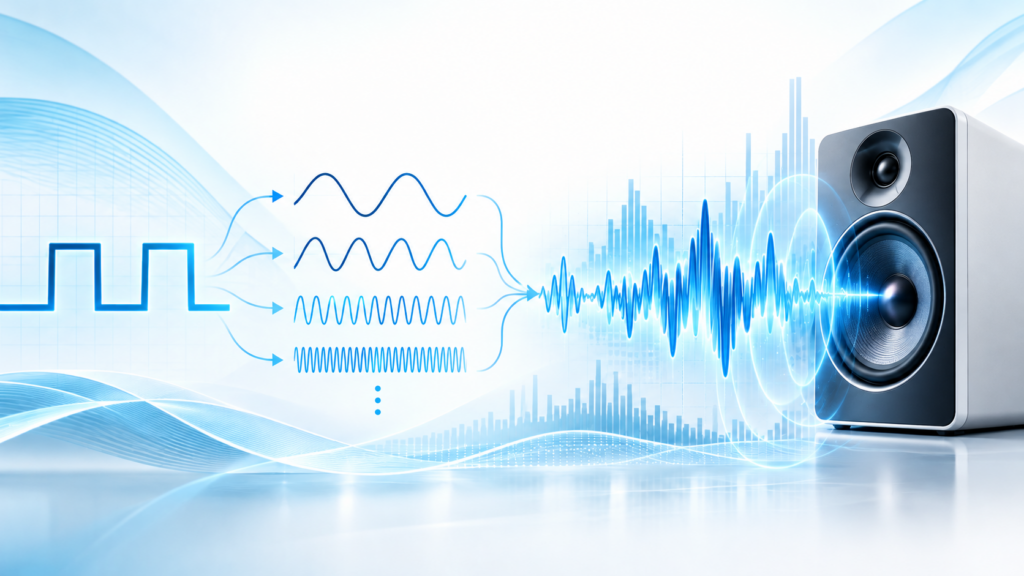

Does a Square Wave Contain Many Frequencies?
When learning about the Fourier Transform, one classic example often appears:A square wave can be decomposed into a fundamental frequency together with multiple sinusoidal harmonics at different frequencies.
This naturally leads to a question: If a speaker is reproducing a square wave, does that mean it is producing many different frequencies at the same time? The answer is: Yes, but it depends on how we describe the signal.
A Speaker Does Not Perform a Fourier Transform First
Suppose a signal generator outputs a square wave and sends it through an amplifier to a speaker. From the speaker’s point of view, it receives an electrical signal that varies over time. The voice coil is driven by this signal, causing the diaphragm to move according to the input waveform and push the surrounding air to generate sound. The speaker does not internally think:“This square wave contains 1 kHz, 3 kHz, 5 kHz, and so on, so I need to reproduce each frequency separately.” It simply moves according to the instantaneous changes in the input signal. In other words, from the Time Domain perspective, the speaker is reproducing a waveform.
So Where Do the Multiple Frequencies Come From?
To understand that, we need to look at the signal in the Frequency Domain. The same square wave can be represented through Fourier analysis as a combination of sine waves at different frequencies. Therefore:
Time-domain view: it is a square wave.
Frequency-domain view: it contains a fundamental frequency and multiple harmonics.
These two descriptions do not conflict with each other; they are simply two ways of describing the same audio signal. Therefore, from the frequency-domain perspective, we can indeed say: The speaker is reproducing multiple frequency components at the same time. However, this does not mean that the speaker itself splits the signal into separate sine waves. Those frequency components are already contained within the complex waveform itself.
How Can One Diaphragm Reproduce Multiple Frequencies at Once?
This is another point that can easily cause confusion. At any given instant, a speaker diaphragm has one actual position and motion state. It is not necessary to imagine one part moving at 1 kHz while another part separately moves at 3 kHz. A better way to understand it is: When different frequency components are added together, they form a new complex motion pattern, and the diaphragm follows this combined waveform. For example, when two sine waves are added together, an oscilloscope does not show them as two separate signals at the output. Instead, it displays a new combined waveform. A speaker diaphragm behaves in the same way. In an ideal linear system, this is known as the Principle of Superposition in acoustics and signal processing.
Can the Human Ear Hear Many Frequencies at the Same Time?
Yes. Most sounds we hear in everyday life are not single-frequency signals. Human voices, musical instruments, car engines, and even a simple hand clap contain many different frequency components. The cochlea in the human ear acts somewhat like a frequency analyzer. Different frequencies produce stronger responses at different locations along the basilar membrane, and the nervous system processes this information further. For this reason, the auditory system is sometimes compared to a bank of frequency filters. Strictly speaking, however, the human ear is not literally performing a mathematical Fourier Transform. Fourier analysis is simply a very useful mathematical way to describe the different frequency components contained in complex sounds.
Can a Real Speaker Reproduce a Perfect Square Wave?
There is also an important difference between theory and real-world behavior. A mathematically ideal square wave requires a very large number of harmonics, theoretically extending to infinitely high frequencies. Real speakers, however, have limited frequency response and bandwidth, so they cannot reproduce infinitely high-frequency components. Therefore, when a square wave is sent to a real speaker, the resulting acoustic pressure waveform will usually not remain perfectly square. Its edges become smoother because the high-frequency components are limited. This again demonstrates that: The shape of a waveform is closely related to the frequency components it contains.
In Simple Terms
The question “Can a speaker produce many frequencies at the same time?” can be answered from two different perspectives: From the time-domain perspective, the speaker diaphragm is reproducing a complex waveform that changes over time. From the frequency-domain perspective, that waveform can contain many different frequencies, so the speaker can also be described as reproducing multiple frequency components simultaneously. The speaker does not need to perform a Fourier Transform on the signal itself; Fourier analysis is simply another way for us to understand the same complex sound. This is why a single speaker diaphragm, although it appears to simply move back and forth, can reproduce complex audio containing bass, vocals, high frequencies, and many different harmonics.