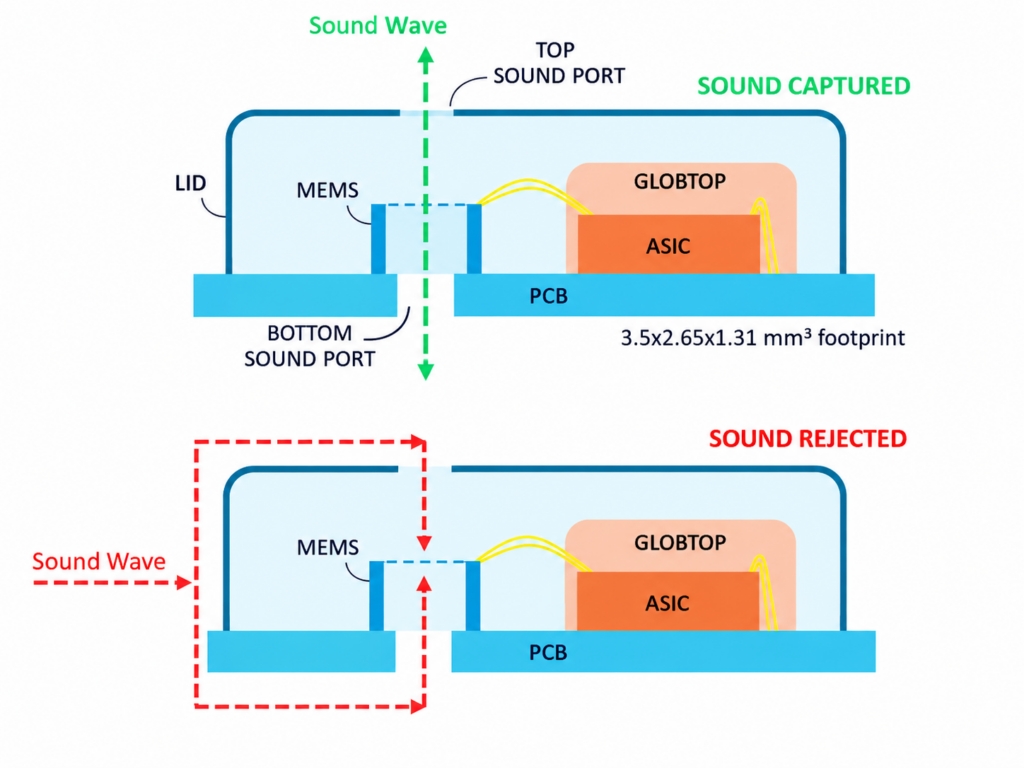

Most conventional MEMS microphones use an omnidirectional design, meaning they can pick up sound from all directions. If directional pickup is required, multiple microphones and additional signal processing are often needed. Soundskrit takes a different approach by redesigning the MEMS transducer itself to achieve directional pickup. One of its key features is the use of Two Sound Ports, allowing sound to reach the MEMS sensing structure through different acoustic paths.
When sound arrives from the main pickup direction, an acoustic difference is created between the two sound ports, allowing the MEMS structure to respond normally. In contrast, when sound arrives from the side, the signals at the two sound ports become more similar and partially cancel each other. This helps reduce side pickup and creates natural directional behavior.
Previous attempts using conventional omnidirectional MEMS transducers in a similar configuration could result in lower sensitivity. Soundskrit therefore redesigned the MEMS transducer specifically for the dual-port structure, allowing it to achieve directionality while maintaining higher sensitivity.
Another key advantage is its compact size. The device shown in the presentation has a footprint of approximately 3.5 × 2.65 × 1.31 mm³, allowing it to retain the compact form factor of MEMS technology while directly providing directional pickup capability.
AATC is an authorized distributor of Soundskrit Directional MEMS Microphones, providing support from product selection and technical consultation to testing and product integration. If your product requires more precise directional pickup, side-noise suppression, or a compact MEMS microphone solution, please contact AATC to learn more.
For more information about Soundskrit MEMS, please visit AATC’s product pages: SKR0710 SKR0610 SKR0410