

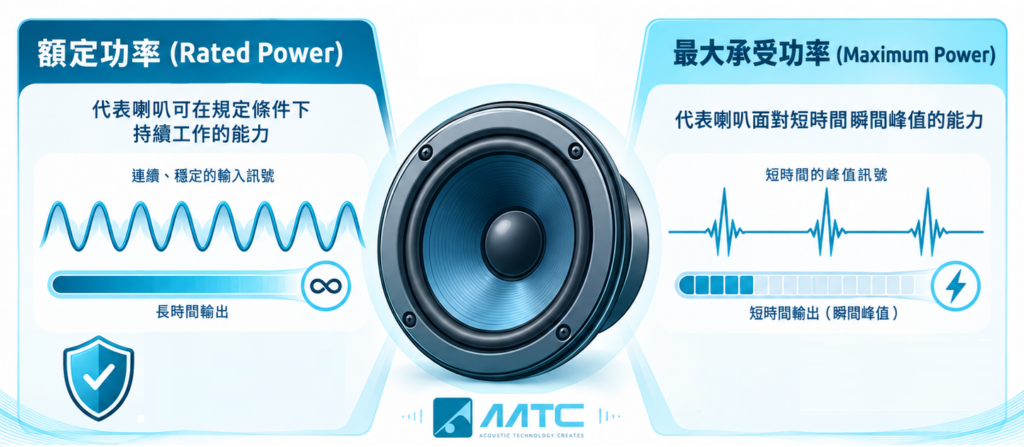
In speaker specifications, we often see terms such as Rated Power, Maximum Power, and Peak Power. Although all of these values are expressed in watts, they represent different test conditions and meanings. In general, rated power can be understood as the power level at which a speaker can operate continuously and reliably under specified conditions. The actual test method depends on the manufacturer or applicable standard. Some tests use sine waves and monitor Total Harmonic Distortion (THD), while others use specially defined noise signals and frequency bands for durability testing.
If a sine wave and THD are used as the evaluation criteria, an acceptable Total Harmonic Distortion (THD) limit can first be defined. The input power is then gradually increased while observing how the speaker distortion changes. For example, suppose the THD limit for a speaker is set at 3%. If the speaker can maintain distortion below this limit up to an input power of 5 W, but distortion begins to increase significantly above 5 W, then under this particular test condition, 5 W may be considered one of the speaker’s rated operating power limits. Under rated operating conditions, the speaker must not only maintain acceptable acoustic performance but also avoid thermal or mechanical overload during long-term operation. For example, excessive voice-coil temperature may damage the coil, adhesives, or other materials, while excessive diaphragm excursion may cause mechanical problems in the surround, spider, or voice-coil structure.
However, real-world audio is not a continuous and constant sine wave. Music, speech, warning sounds, and other audio signals all contain transient peaks of different amplitudes. The power of these peaks can temporarily rise far above the average power level.
Because these peaks are very short, the voice coil normally does not accumulate heat as quickly as it would under continuous power. Therefore, a speaker can usually withstand short-term input power above its rated power. This is one reason why specifications such as Maximum Power or Peak Power are also provided.
For some products or design practices, short-term power handling may be around 1.5 to 3 times the rated power. However, this is not a fixed rule for every speaker. The actual value depends on the driver structure, heat dissipation, maximum excursion, and the test standard being used.
For example, if a speaker has a rated power of 5 W and the design target allows it to withstand three times the rated power for a short period, its short-term maximum power handling may be approximately 15 W. However, this does not mean that the speaker can operate continuously at 15 W.
This is an important point when reading speaker specifications: Rated Power, Maximum Power, and Peak Power should not be treated as the same specification. When comparing different speakers, we should not simply compare the wattage values. The test signal, test duration, frequency range, distortion limits, and evaluation criteria used by each manufacturer should also be checked. Simply put, rated power tells us how much power a speaker can handle continuously, while maximum or peak power tells us how much it may withstand for a short period. Looking at both specifications together gives a more complete understanding of the speaker’s actual power-handling capability.
If a sine wave and THD are used as the evaluation criteria, an acceptable Total Harmonic Distortion (THD) limit can first be defined. The input power is then gradually increased while observing how the speaker distortion changes. For example, suppose the THD limit for a speaker is set at 3%. If the speaker can maintain distortion below this limit up to an input power of 5 W, but distortion begins to increase significantly above 5 W, then under this particular test condition, 5 W may be considered one of the speaker’s rated operating power limits. Under rated operating conditions, the speaker must not only maintain acceptable acoustic performance but also avoid thermal or mechanical overload during long-term operation. For example, excessive voice-coil temperature may damage the coil, adhesives, or other materials, while excessive diaphragm excursion may cause mechanical problems in the surround, spider, or voice-coil structure.
However, real-world audio is not a continuous and constant sine wave. Music, speech, warning sounds, and other audio signals all contain transient peaks of different amplitudes. The power of these peaks can temporarily rise far above the average power level.
Because these peaks are very short, the voice coil normally does not accumulate heat as quickly as it would under continuous power. Therefore, a speaker can usually withstand short-term input power above its rated power. This is one reason why specifications such as Maximum Power or Peak Power are also provided.
For some products or design practices, short-term power handling may be around 1.5 to 3 times the rated power. However, this is not a fixed rule for every speaker. The actual value depends on the driver structure, heat dissipation, maximum excursion, and the test standard being used.
For example, if a speaker has a rated power of 5 W and the design target allows it to withstand three times the rated power for a short period, its short-term maximum power handling may be approximately 15 W. However, this does not mean that the speaker can operate continuously at 15 W.
This is an important point when reading speaker specifications: Rated Power, Maximum Power, and Peak Power should not be treated as the same specification. When comparing different speakers, we should not simply compare the wattage values. The test signal, test duration, frequency range, distortion limits, and evaluation criteria used by each manufacturer should also be checked. Simply put, rated power tells us how much power a speaker can handle continuously, while maximum or peak power tells us how much it may withstand for a short period. Looking at both specifications together gives a more complete understanding of the speaker’s actual power-handling capability.
 .
.