

When talking about tweeters, many people may think of a hemispherical or dome-shaped diaphragm design, commonly known as a dome tweeter.
One of the main reasons for using a dome-shaped tweeter diaphragm is that a larger voice coil can be mounted along the edge of the dome.
A larger voice coil radius helps improve heat dissipation and allows the speaker to handle higher input power. In addition, dome diaphragms are usually made of thin and lightweight materials, allowing them to maintain good vibration response at high frequencies and helping to increase sound pressure output.
However, speaker design often involves trade-offs. Although a dome-shaped diaphragm has the advantages mentioned above,
its edge does not behave like an ideal boundary that can fully absorb or terminate wave propagation.
Instead, the edge of the diaphragm may reflect vibration waves traveling along the dome surface, which can lead to standing waves.
In comparison, the traditional cone shape commonly used in woofers may, in some cases, be more effective at reducing this type of reflection.
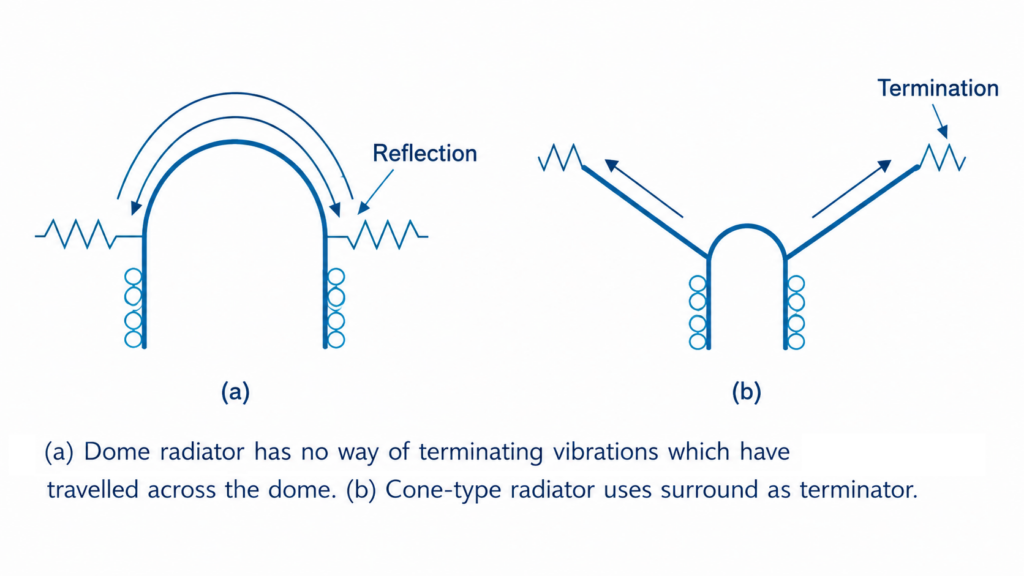 As shown in figure (a), a dome tweeter diaphragm is usually driven by the voice coil around its edge.
This means that the vibration energy actually enters the diaphragm from the edge. Based on the structure of a typical dome diaphragm,
the vibration wave travels along the diaphragm surface from one side to the other and is then reflected back at the boundary.
At the same time, the opposite side also produces its own vibration wave, which travels and reflects in the opposite direction.
When these vibration waves overlap, they may create an uneven vibration pattern.
This phenomenon is especially likely to occur in lossless or harder diaphragm materials, often referred to as a lossless / hard diaphragm.
Because this type of material dissipates less vibration energy, the vibration waves are not easily absorbed as they travel across the diaphragm surface.
As a result, reflection and standing wave effects become more noticeable.
To reduce this type of issue, some designs use a softer diaphragm with more damping, known as a lossy / soft diaphragm.
This type of diaphragm can absorb part of the vibration energy during wave propagation, helping to reduce reflection and standing wave effects.
However, the damping effect on a dome-shaped diaphragm is different from that of a traditional cone diaphragm.
In a traditional cone diaphragm, vibration usually travels from the center toward the outer edge.
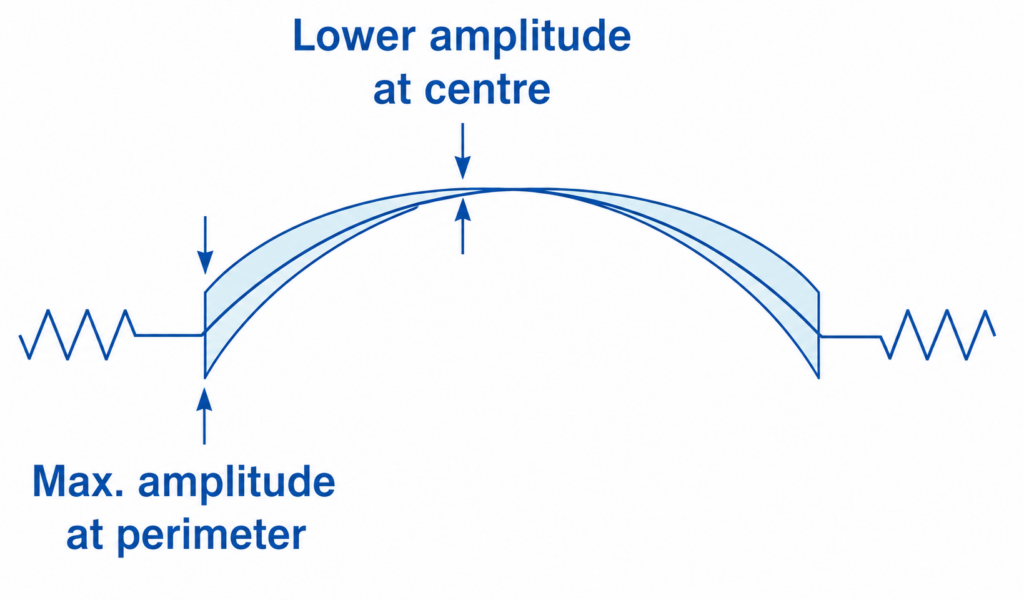
In a dome tweeter diaphragm, however, vibration travels from the edge toward the center.
Therefore, in a soft dome diaphragm, as the vibration wave gradually moves toward the center, its amplitude may gradually decrease, as shown in the figure below.
However, a soft diaphragm also has its drawbacks. If the dome diaphragm is too soft, the vibration at the center may gradually become decoupled from the control of the voice coil at the edge.
In this case, the center and edge of the diaphragm may act like separate radiating areas.
They may also interfere with each other, making the high-frequency response or directivity less stable.
Finally, we can also clear up a common misconception: a dome tweeter diaphragm does not necessarily radiate sound evenly like an ideal spherical sound source.
The following figure shows two diagrams. Which one do you think is closer to the real situation?
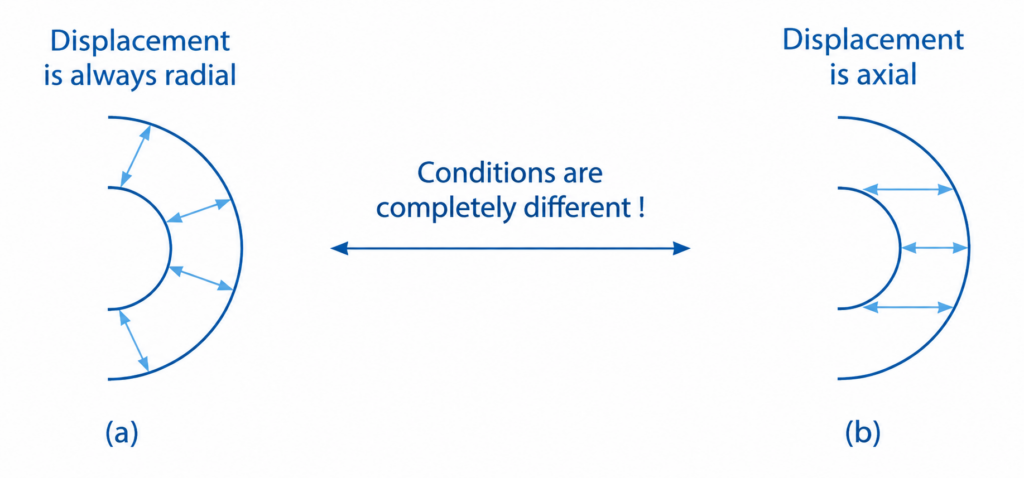
If figure (a) were correct, it would mean that the dome tweeter diaphragm behaves like an ideal spherical sound source and radiates sound evenly in all directions.
However, this is not the actual behavior of a dome tweeter diaphragm.
The situation shown in figure (b) is closer to reality: high-frequency sound tends to have stronger directivity, and greater attenuation can occur in the off-axis direction. In other words, the sound pressure level drops more noticeably off-axis.
Therefore, although dome-shaped tweeter diaphragms are very common, they are not perfect spherical sound sources.
They have advantages in high-frequency extension, efficiency, and structural design, but diaphragm material, edge reflection, standing waves, center-area control, and off-axis response still need to be considered.
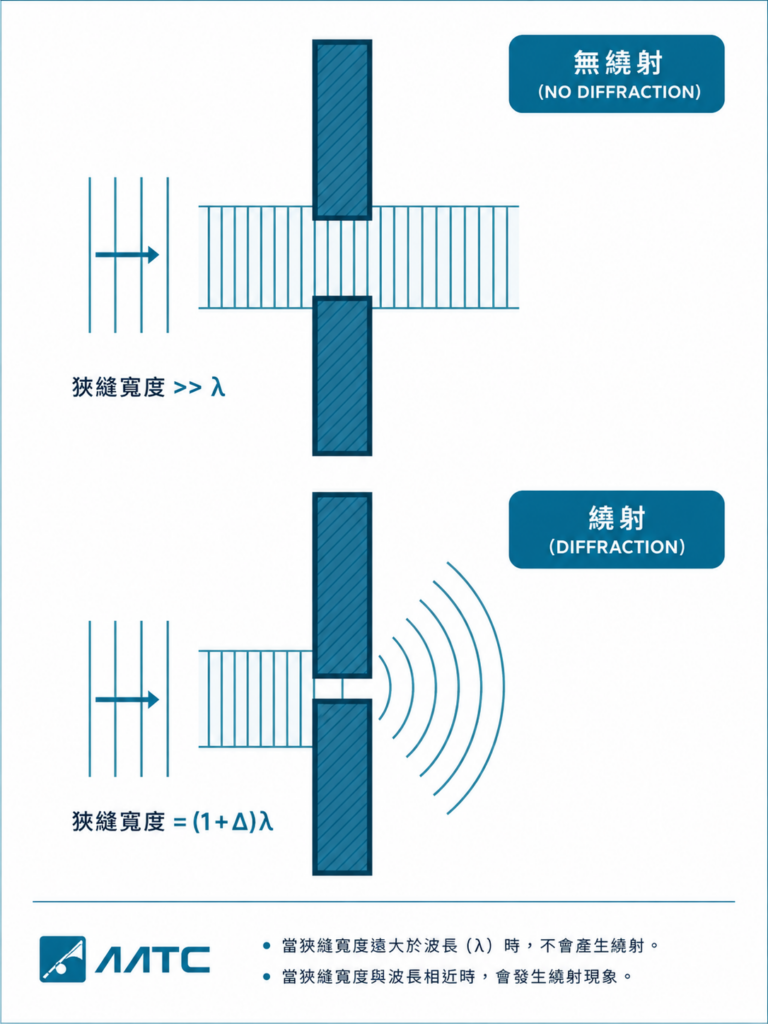
If the sound source has already produced high-frequency sound that is closer to a plane wave, but we want to make it spread more like a spherical wave again,
a narrower tube or acoustic structure can be used to adjust the wavefront. However, the tube diameter should not be too large.
If the tube is too wide, the wave shape will not be effectively reshaped, and the result will be limited, as shown in the figure below.
Simply put, tweeters often use dome-shaped diaphragms because this structure helps with voice coil installation, weight control, and high-frequency performance.
However, in actual design, dome diaphragms may also introduce issues such as reflection, standing waves, and directivity.
Therefore, a good tweeter design is not only about the diaphragm shape. It also needs to consider material, structure, boundary conditions, and actual acoustic performance.